
If you've been looking for a job lately, you've probably seen it.
You find a job that looks perfect. You read the description, research the company, tweak your resume, and fill out the application. Then nothing happens.
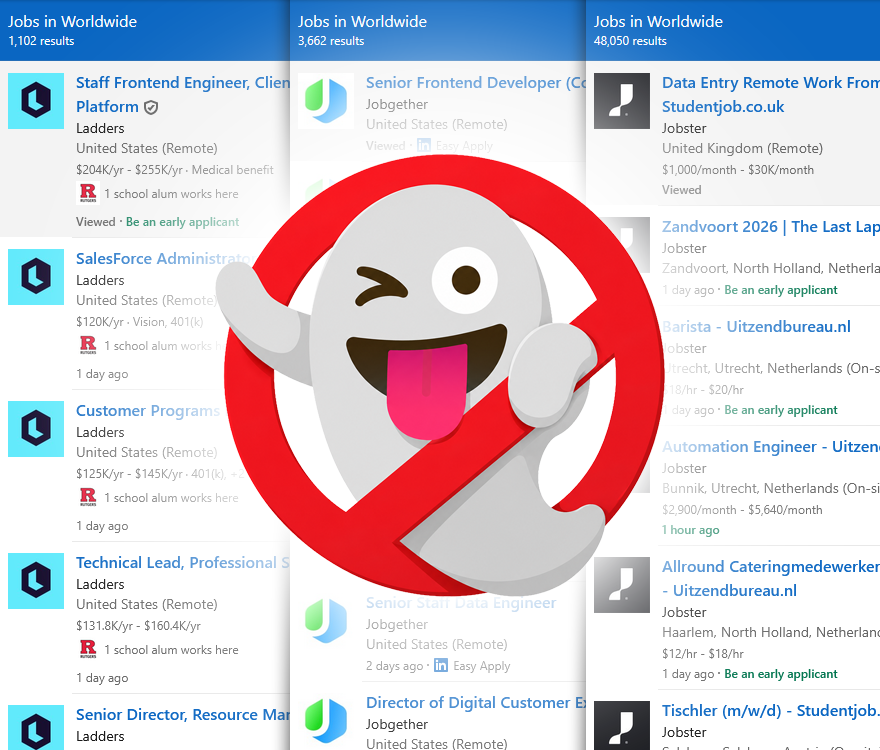
A few weeks later, you might even see the exact same job again, somehow back near the top of the search results as if it's brand new.
Was the company ever actually hiring?
Maybe. Maybe not.
That's where ghost jobs come in.
And they're more complicated than companies simply posting fake jobs.
Ghost jobs can look exactly like real openings. The hard part is knowing whether there's actually a job on the other side.
What is a ghost job?
A ghost job is generally a job posting that appears to represent an active opportunity even though there isn't actually a current position being filled.
Sometimes the company is collecting resumes for the future. Sometimes hiring plans changed and the listing never came down. Sometimes an employer already has another candidate in mind. And sometimes the job never represented a real opening in the first place.
There isn't an official industry taxonomy that divides ghost jobs into neat categories. Some things commonly lumped in with ghost jobs, like evergreen recruiting and job scams, aren't technically ghost jobs in every situation either.
But there are a handful of common ways jobs with little or no immediate opportunity behind them end up in search results.
The list below isn't a scientific ranking because reliable data doesn't exist to tell us exactly how large each category is.
1. Stale or outdated job postings
This is probably the simplest version.
A real job gets posted. Then someone gets hired, the company cancels the position, the budget disappears, or hiring gets put on hold.
The job is no longer active, but the listing is.
Sometimes it's still sitting on the employer's own career site. Other times copies continue circulating through job boards and aggregators after the original listing disappears.
A job that was completely legitimate when it was published can eventually become stale everywhere else.
Role sees just how long some listings stick around in its own data. Role analyzed nearly 10 million jobs pulled directly from employer career sites and found that about 1 in 5 were still live after 90 days.
That doesn't mean one in five jobs are ghosts. Some positions genuinely take months to fill, and others involve continuous hiring.
But it shows how large the pool of months-old listings is for job seekers trying to figure out which opportunities are actually current.
The finding was remarkably consistent too. Across five monthly cohorts from December 2025 through April 2026, between 18% and 20% of listings were still live after 90 days.
2. Third-party and duplicate job postings
This is where the problem can spread.
An employer publishes one job. A job board distributes it. An aggregator picks it up. A staffing company may advertise it too. Other sites can copy those copies.
Before long, one opening can exist in several places across the web.
Some are simply duplicate job postings pointing back to a legitimate position. The problem is that those copies don't always disappear when the original does.
Third-party recruiters can also advertise roles while building pools of candidates for current or future clients. That doesn't make staffing firms inherently bad. Plenty fill real positions every day.
But every extra layer between the applicant and the employer makes it harder to know where a listing originated, how old it really is, and whether the company is still hiring.
SHRM has highlighted stale listings, duplicate ads, evergreen recruiting, and other practices as contributors to what job seekers experience as ghost jobs.
3. Evergreen job postings and talent pooling
Evergreen jobs and talent pools are legitimate recruiting practices.
A hospital might constantly need nurses. A restaurant chain might regularly hire servers. A large company might always be interested in salespeople or software engineers.
Instead of opening a new requisition every time someone is needed, an employer can keep a listing open and continuously collect applicants.
There's nothing wrong with that if the company is actually hiring on an ongoing basis.
The gray area starts when there isn't an opening today.
The applicant sees: "We're hiring. Apply now."
What the employer may really mean is: "We hire people like this periodically, so send us your resume in case something opens later."
Those are different propositions.
The problem isn't talent pooling. It's that applicants often aren't told when they're applying to a pipeline instead of a current vacancy.
4. Jobs posted for appearances
There's no widely accepted HR term for this particular subtype, so the plain-English description is probably the clearest one.
Sometimes looking like you're hiring has value even when hiring isn't the main goal.
Open positions can make a company look like it's growing. They can signal momentum to investors, competitors, customers, and prospective employees. They can make overworked employees think help is coming or make current employees feel more replaceable.
That sounds cynical, but hiring managers have admitted to these motivations.
In a 2024 ResumeBuilder survey of hiring managers whose companies said they had posted fake jobs, 67% said one reason was to appear open to outside talent, 66% said to create the appearance of growth, 63% said to make employees believe their workloads would be reduced, and 62% said to make employees feel replaceable.
Respondents could select multiple reasons, so those figures aren't percentages of all ghost jobs. The survey also doesn't tell us how common the practice is across the entire labor market.
It does show that it happens.
5. Internal-candidate postings
Some jobs really do need to be filled, but an outside applicant may have little realistic chance of getting them.
Maybe a manager already has an internal employee in mind. Maybe a contractor is expected to move into the permanent position. Maybe an employer's internal process calls for the role to be posted anyway.
There are also specific situations where employers have legal recruiting or posting obligations, but there is not a blanket federal law requiring every private employer to publicly advertise every position.
The job itself may be real.
What's questionable is whether it represents a realistic opportunity for someone applying from outside the company.
6. Job scams
Finally, some listings aren't ghost jobs at all. They're job scams.
A ghost job usually involves a real employer or real-looking position that isn't actually being filled. A job scam involves fraud.
Scammers can impersonate legitimate companies or recruiters to collect money, banking details, identity documents, Social Security numbers, or other sensitive information.
According to the Federal Trade Commission, reports of job scams nearly tripled from 2020 to 2024, while reported losses jumped from $90 million to $501 million.
Technically, job scams and ghost jobs are different problems.
But to someone scrolling through search results, they raise the same basic question:
Is this opportunity actually real?
So how many jobs are actually ghosts?
Nobody knows exactly.
One of the better outside estimates comes from hiring platform Greenhouse, which says 18% to 22% of jobs posted on its platform in any given quarter are classified as ghost jobs.
That doesn't mean roughly one in five jobs across the entire internet is fake. Different studies use different definitions, populations, and methods.
Role's own 90-day data doesn't mean that either. A months-old job isn't automatically a ghost job.
Some positions take a long time to fill. Some companies hire continuously. Hiring plans change.
The real problem is that job seekers usually can't tell which explanation applies.
That's what makes ghost jobs so difficult to measure in the first place.
Lawmakers are starting to notice
Governments are beginning to focus on a pretty simple idea: tell applicants whether there is actually a vacancy.
In New York, S8877 passed both the Senate and Assembly in 2026. The proposal would require covered job advertisements to disclose whether an employer intends to fill a current vacancy, when it expects to fill it, or whether it is simply collecting resumes for future openings. It would also require filled postings to be removed within two weeks. As of August 2026, the bill has passed both chambers but has not yet become law.
Ontario has already enacted similar transparency requirements. Since January 1, 2026, covered employers generally must state whether a publicly advertised job is for an existing vacancy under the province's job-posting transparency requirements.
The principle behind these efforts is straightforward.
Companies can recruit for the future. They should just tell people when that's what they're doing.
The bigger problem is trust
A stale listing is different from an evergreen recruiting pipeline. Both are different from a job where an internal employee is already favored. And all of those are different from a scam.
But in search results, they can look almost identical: Job title. Company. Location. Apply.
The job market doesn't just have a ghost-job problem. It has a source-of-truth problem.
Applying takes time. You research the company, update your resume, answer questions, create another account, and submit the application.
Then you do it again.
People put up with that because they assume they're competing for something real.
A job listing should mean something pretty simple: There is a real employer with a real opportunity that it actually wants someone to fill.
That shouldn't be too much to ask.
How Role is tackling ghost jobs and reposts
Ghost jobs are a big part of why we're building Role differently.
The goal is simple: No ghosts. No reposts.
Role pulls jobs directly from employer career websites instead of relying on third-party recruiter and staffing listings. That helps cut out third-party scams, duplicate copies, and old listings still circulating after they've disappeared from the employer's site.
We also remove listings after 180 days to keep stale jobs out of search results and are working on analyzing job descriptions and other signals to identify listings that may be evergreen pipelines or otherwise may not represent current openings.
There's another difference too: Role isn't built around sponsored job placement.
Large job platforms allow employers to pay for more exposure. Indeed, for example, says its Sponsored Jobs receive more visibility in search results.
There's nothing wrong with promoting a legitimate job. But when visibility can be bought, search results aren't driven only by what's newest or most relevant to the job seeker.
Role's goal isn't to keep resurfacing the same jobs because someone paid for more exposure.
It's to help you find real opportunities you haven't already seen.
Real jobs. Direct from employers. No ghosts. No reposts.
Methodology: Role analyzed 9,697,751 jobs first discovered directly on employer career sites across monthly cohorts from December 2025 through April 2026. A job was counted as live at 90 days if it remained active at least 90 days after Role first discovered it. Across the five cohorts, 18% to 20% remained live at 90 days.